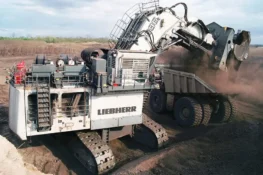
In the rough and tumble world of mining machinery, some names roar louder than others. The Komatsu-Demag H285S may not be as widely known today, but during its heyday, it stood as a behemoth among men—a hydraulic excavator so powerful, it could dig like a titan. It wasn’t just big. It was legendary.
Let’s crack open the history books and engine compartments to take a look at one of the most underrated giants of the dirt-moving world.
The Specs: Breaking It Down
Don’t worry—we’ll keep the techno-jargon to a minimum. Here’s what made the H285S such a standout:
Operating weight: ~263 tons (depending on configuration)
Engine: Dual diesel engines, usually 2 × Komatsu SDA16V160 or similar, combining for 2,800–3,000 HP
Bucket capacity: Roughly 26–28 cubic meters (34–37 cubic yards) – enough to swallow a family sedan
Hydraulic system: Advanced twin-circuit system for independent boom and arm control
Digging force: Think of a T-Rex with hydraulics – over 1300 kN
Undercarriage: Extra-wide tracks for better stability on rough, uneven mine terrain
In simple terms: this thing could eat dirt for breakfast, lunch, and dinner—and still come back hungry for more.
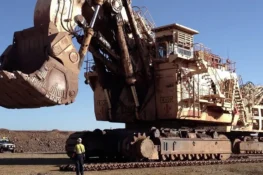
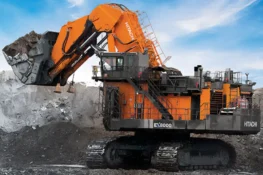
The massive frame of the Komatsu-Demag H285S dominates the mining pit, built for extreme digging power and nonstop heavy-duty performance.
What Was It Used For?
You don’t build a monster like the H285S to just dig out a garden pond. This machine was purpose-built for open-pit mining, especially in coal, iron ore, and copper mines. With its enormous shovel and aggressive digging force, it was ideal for:
Removing overburden (aka “the stuff on top of the good stuff”)
Loading massive mining trucks like the Komatsu 830E or Caterpillar 793
Working in extreme conditions where uptime, power, and durability are life or death
These giants were usually paired with fleets of haul trucks in some of the world’s biggest and deepest surface mines—from Australia to South Africa to North America.
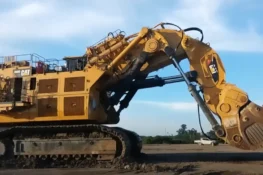
The massive bucket of the Komatsu-Demag H285S scoops up an enormous load of earth and rock—hauling up to 35 tons in a single bite with ease.
A Short but Fierce Legacy
So what happened to it?
The Komatsu-Demag H285S was the product of Demag’s hydraulic expertise and Komatsu’s global reach, born in the early 2000s during a fruitful partnership. But as mining tech evolved and the market leaned toward newer, more efficient models (like the Komatsu PC8000), the H285S slowly phased out of production.
Still, during its operational prime, it was a favorite among operators for its surprising smoothness, stability, and raw muscle. And let’s be honest—there’s just something special about watching a 260-ton machine glide across the quarry like a steel ballerina.
Fun Facts: For the Nerds and Gearheads
🛠️ Twin Engines: Two engines meant the H285S could keep working even if one failed—a built-in backup plan. Pretty smart for a machine that could crush a Land Cruiser.
🎮 Joystick Precision: Operators praised its joystick-based controls for being responsive and comfortable, even on 12-hour shifts.
🐾 Caterpillar-sized Tracks: Its undercarriage was so wide that it left track marks like a bulldozer on steroids.
🔧 Maintenance Access: It featured multiple catwalks and service platforms—because fixing a hydraulic monster should be less of a nightmare.
Why It Still Matters
Even though the H285S no longer rolls off production lines, it represents a turning point in hydraulic excavator design—a balance between brute strength and operator finesse. It helped pave the way for today’s ultra-efficient mining machines that dig smarter, not just harder.
Some units are still operational in remote mining sites, quietly reminding us that true engineering greatness doesn’t just disappear—it just keeps digging.
A Gentle Giant with a Hydraulic Heart
The Komatsu-Demag H285S might not be the first name you think of in mining, but it deserves a spot in the hydraulic hall of fame. Built to last, engineered to perform, and respected by all who ran it, the H285S was more than just an excavator—it was a worksite legend.
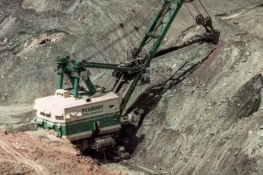
Built in the 1960s, Big Brutus was an 11-million-pound electric shovel that worked the Kansas coal fields. Now silent, it stands as a monument to human ambition.